by Petros Kasfikis, Washington Correspondent –
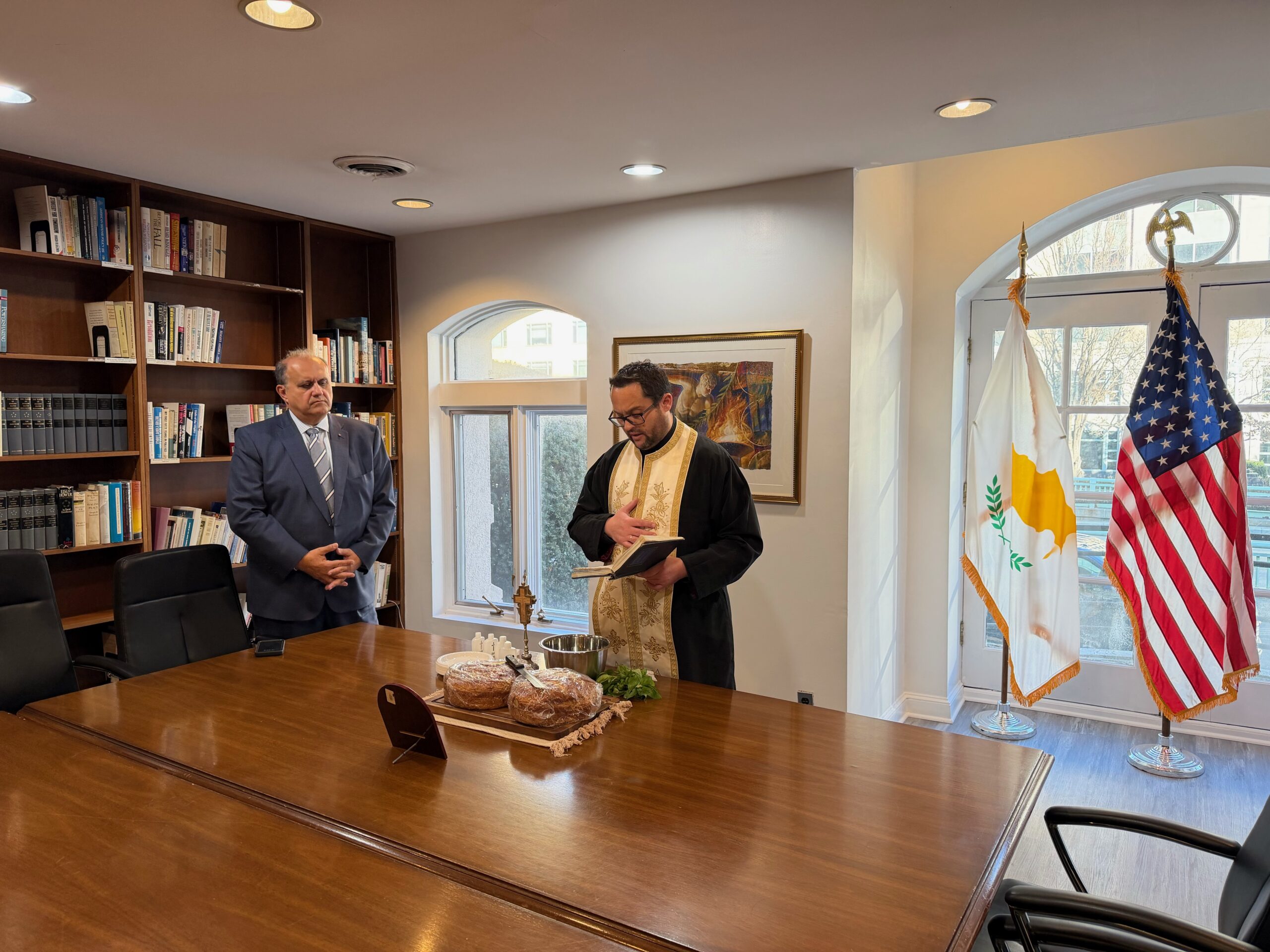
At first glance, the American Hellenic Institute’s annual vasilopita for its staff, the New Year’s cake baked with a hidden coin, looked like just another familiar community ritual.
And yet, beneath the surface, the evening pointed to something more consequential than who would find the coin. It raised a quieter, more difficult question about the future of Greek America.
The blessing was offered by Father Zisis Lappas of the Greek Orthodox Church of Saint Katherine in Falls Church in Virginia. A priest whose presence extends beyond the sanctuary, and whose outlook reflects a broader awareness of where Hellenism in the United States now stands.
We are living through a paradox.
Orthodox Christianity in America is enjoying a modest but genuine revival. Churches are fuller than they were a decade ago. Converts are arriving in noticeable numbers. The Eastern tradition, once seen as distant and insular, now attracts Americans searching for depth and discipline in an unsettled cultural moment.
At the same time, many younger Greek Americans are quietly disengaging from the political and historical concerns that once anchored the community.
For some, Greek identity has narrowed to a handful of cultural markers: a few phrases of the language, memories of church festivals, summer visits, familiar food. For others, Greece has become little more than an appealing destination. A place to visit, not a story to inherit.
What recedes is not sentiment, but substance.
Historical awareness weakens. Political consciousness thins. Collective memory becomes optional. This is not a cosmetic change. It alters the character of the community itself.
For decades, organizations such as the American Hellenic Institute have worked to ensure that Greek and Cypriot issues remained visible in Washington. They built relationships, cultivated credibility, and translated diaspora concerns into policy language that mattered.
That mission is now harder. Not because advocacy has become impossible, but because the audience that once sustained it is less certain of why it matters.
Against this backdrop, the conversation between AHI President Nick Larigakis and Father Zisis carried particular weight. They spoke about cooperation. About connecting political engagement with parish life. Father Zisis invited Larigakis to speak at Saint Catherine’s, signaling an interest in deeper collaboration.
On paper, it was a modest gesture.
In practice, it reflected something larger: the recognition that parishes remain among the last structured and vibrant spaces where Greek American identity is still actively formed.
They are where generations overlap. Where memory is transmitted. Where faith intersects with civic responsibility.
But institutions alone do not sustain themselves.
They depend on leadership. On clergy who understand that pastoral work and cultural stewardship are not competing roles. On priests who follow national issues, engage their communities intellectually, and view Hellenism as something living rather than ceremonial.
That requires preparation. It requires training. It requires ongoing connection to contemporary Greece, not as a nostalgic symbol, but as a political and social reality.
Not out of sentiment. But out of necessity.
It also explains why clergy from Greece can play an important role, when carefully integrated into American parish life. Father Zisis, who came from Xanthi to the United States and eventually served a suburban Washington congregation, brought with him not only theological formation, but historical perspective and lived continuity.
These things matter. Because without knowledge, without institutional memory, and without intentional transmission, diaspora communities drift. They become cultural showcases rather than civic actors. Festivals rather than forums. Heritage rather than responsibility. They become pleasant. Harmless. And eventually, irrelevant.
That is the real coin hidden inside a vasilopita in Washington.