WASHINGTON, DC —
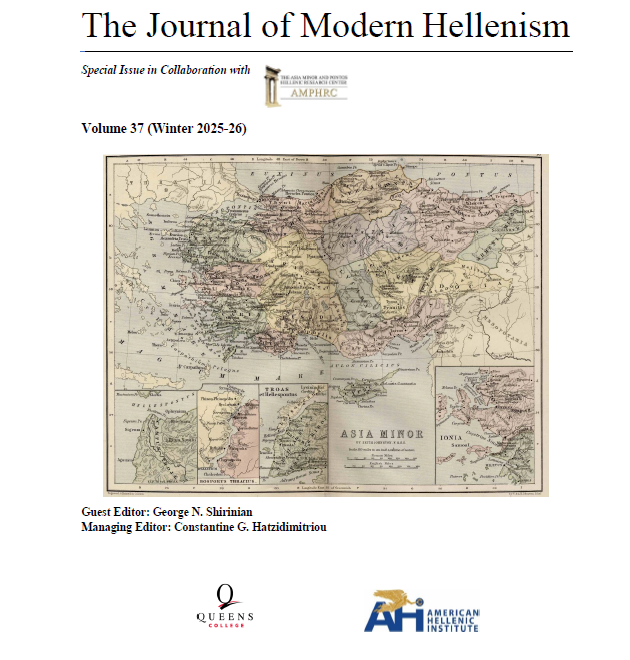
The American Hellenic Institute Foundation (AHIF), the Center for Byzantine and Modern Greek Studies at Queens College, CUNY, and the Asia Minor and Pontos Hellenic Research Center jointly announced the release of a special thematic digital issue of the Journal of Modern Hellenism. Published as JMH 37 (Winter 2025–26), the issue is devoted to the genocide of the Christian populations of the Ottoman Empire and is available free of charge through the AHIF publications website: http://americanhellenicinstitute.org/new-page-nphwe
This volume continues the collaboration between AHIF and the Center for Byzantine and Modern Greek Studies (Queens College, CUNY) in the co-publication of the Journal of Modern Hellenism and presents a focused scholarly examination of the shared historical experiences of Greeks, Armenians, and Assyrians during the early twentieth century.
This scholarship presented in this volume also reflects the scholarly and educational work of the Asia Minor and Pontos Hellenic Research Center, whose mission has been to advance rigorous, comparative research on the genocide of the Christian populations of the Ottoman Empire. Founded to promote serious academic inquiry and public education, the Center has played a key role in fostering the comparative framework—alongside Armenian and Assyrian experiences—that informs the scholarship presented in this volume.
This special issue is dedicated to the memory of George Mavropoulos (1938–2024), founder of the Asia Minor and Pontos Hellenic Research Center. Mavropoulos devoted decades to advancing serious, balanced, and inclusive scholarship on the genocide of Ottoman Christians. Dr. Hatzidimitriou describes his life’s work as marked by a “tireless and unselfish devotion to truth, justice and to remembering those lost during that dark period.”
Guest-edited by historian and genocide scholar George N. Shirinian, JMH 37 (Winter 2025–26) examines a common historical trajectory “from…second-class citizens to violent persecution and genocide, to forcible expulsion and dispersion.” The issue also addresses the enduring post-genocidal legacy of these events, including intergenerational psychological trauma and the ways in which genocide and its aftermath have shaped modern identities.
As Dr. Constantine G. Hatzidimitriou, Managing Editor of the Journal of Modern Hellenism, notes in the Preface, the subject of this issue “resonates not only with Greeks but with other ethnicities that shared a common catastrophic and tragic experience,” and remains relevant beyond its historical context, as similar patterns of victimization persist in the contemporary world.
In his Introduction, George Shirinian emphasizes that the genocidal and post-genocidal experience has become “as much a marker of national identity as language, religion, and cultural tradition,” underscoring the importance of studying the Greek experience alongside those of Armenians and Assyrians. This comparative approach, long championed by Mavropoulos, is reflected throughout the volume.
JMH 37 (Winter 2025–26) contains fourteen peer-reviewed scholarly articles, three archival and primary-source studies, and three book reviews, organized into thematic sections.
- Part I: Genocide features nine articles examining the genocides of Greeks, Armenians, and Assyrians during the Ottoman and early Kemalist periods. Topics include state ideology and racism, deportations and massacres, American eyewitness testimony, U.S. institutional involvement, interethnic dimensions of genocide, and mechanisms of memory transmission.
- Part II: Aftermath, Representation and Denial include four articles addressing the political, cultural, and legal consequences of genocide, with studies on postwar territorial claims, religion and culture in Trebizond, memoir and memory, and national-security justifications for mass violence.
- Archives and Sources present three contributions highlighting previously unpublished or underutilized materials, including archaeological and anthropological research, diplomatic and personal correspondence, and documentary evidence related to Asia Minor, Chios, Northern Epirus, and Smyrna.
- Book Reviews assess three recent publications related to the Greek Genocide, Smyrna during World War I, and the Greek War of Independence, offering critical engagement with current scholarship.
The Journal of Modern Hellenism encourages scholarly contributions from emerging and established scholars on the history, language, and culture of Greece and the Greek Diaspora, from Middle Byzantium to the Modern Era. Hellenic Studies is, at its foundations, an interdisciplinary project, and contributions are welcomed from the fields of History, Literary Studies, Anthropology, Archaeology, Paleography, Film Studies, International Studies, and other disciplines that engage with the journal’s themes.
Authors are encouraged to submit completed articles to Dr. Constantine G. Hatzidimitriou at [email protected].
For submission guidelines and publishing information, please visit: https://www.ahifworld.net/jmh.html