ATHENS – [ANA-MPA] [Photo by HelleniQ Energy]
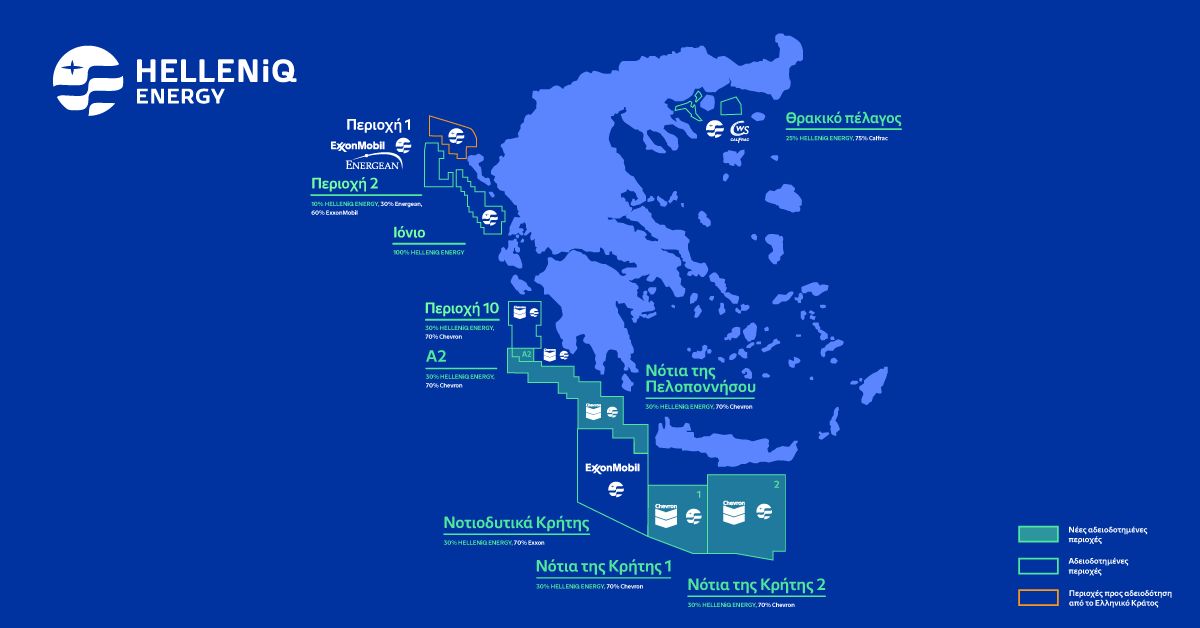
The prospect of a second exploratory drilling operation for hydrocarbons in the Ionian Sea is emerging following the entry of Chevron into Block 10, located in the Gulf of Kyparissia. Andrew Deighan, Chevron’s Director of Exploration for the Middle East and North Africa, described the area as an “interesting and unexplored” region. At the same time, significant developments are expected in Block 2, west of Corfu, where the first exploration well is scheduled to be drilled next February. Chevron’s acquisition of a 70% stake in Block 10 has already been approved in record time. The request was submitted on 28 May, and the relevant procedures were completed last week. As a result, HELLENiQ ENERGY, which previously held the entire concession, will retain a 30% interest.
Block 10 is currently in its second exploration phase. Geological and environmental studies have been completed, along with both two-dimensional (2D) and three-dimensional (3D) seismic surveys. Specifically, 1,210 kilometres of 2D seismic data were acquired in 2022, followed by the first-ever acquisition of 2,416 square kilometres of 3D seismic data, covering 88% of the concession area. The next step will be the acquisition of 3D seismic data in the neighbouring Block A2, followed by an evaluation of the results and a decision on whether to proceed with an exploratory well. Any such drilling activity is expected to take place after 2027–2028.
According to the current timetable, the first well will be drilled in February 2027 in Block 2, west of Corfu. The concession is held by ExxonMobil (60%), Energean (30% and operator), and HELLENiQ ENERGY (10%). This will be Greece’s first hydrocarbon exploration well in approximately forty years, and several key preparatory milestones are imminent. In the coming days, the consortium is expected to finalize the selection of the port that will support drilling operations and logistics. The ports of Patras, Igoumenitsa, and Astakos are under consideration. By early July, the consortium is also expected to submit the Environmental Impact Assessment for the drilling program. The study will include the results of a baseline environmental survey, expected within the next few days, focusing on seabed mapping and assessment.
The estimated natural gas resources in the Asopos-1 prospect within Block 2 are approximately 270 billion cubic metres. By comparison, Greece’s annual natural gas consumption is around 6–7 billion cubic metres. The planned exploratory well will reach a depth of up to 4,622 metres, with drilling costs estimated at 60–70 million euros. Should the initial well prove successful, a second appraisal well may be required. If a commercially viable gas field is confirmed, additional investments of around €5 billion would be needed to develop the project. In such a scenario, revenues for the Greek state over a 20-year period are estimated at approximately 10 billion euros.