NEW YORK, NY – GNUSA
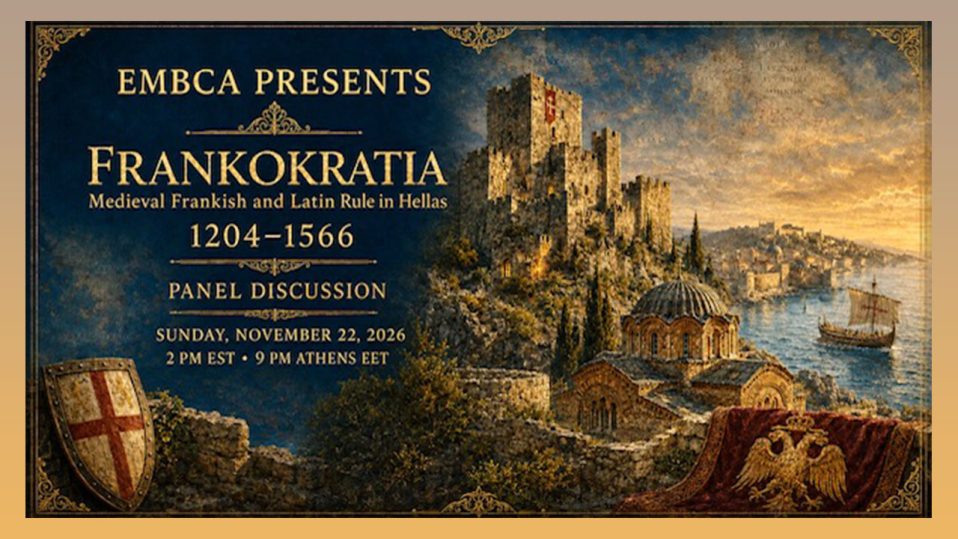
The East Mediterranean Business Culture Alliance (EMBCA) will host a webinar panel discussion titled “Frankokratia: Medieval Frankish and Latin Rule in Hellas, 1204–1566” on Sunday, November 22, at 2 p.m. EST / 9 p.m. Athens EET. The discussion will be introduced and moderated by EMBCA President Lou Katsos, with a panel of scholars and experts that includes Author/ Historian and Host of “History Without Blinders” Dr. Nicholas Nikoloudis; Byzantine Philologist Prof. Dr. Johannes Niehoff- Panagiotidis of the Freie Universitat Berlin; Economist, Author and former senior EU Official Charis Xirouchakis; and Author/Historian Dr. Constantine G. Hatzidimitriou.
The discussion will explore the impact of the Fourth Crusade’s capture of Constantinople in 1204 and the subsequent establishment of Latin rule across parts of the Greek world. Participants will examine the complex period known as Frankokratia, characterized by competing Frankish principalities, Byzantine resistance, shifting alliances, and enduring political and cultural transformations.
Topics will include the Principality of Achaea, the Duchy of Athens, and the Duchy of the Archipelago, as well as the role of trade, dynastic ambition, and military conquest in reshaping medieval Hellas. The panel will also discuss important historical sites such as Chlemoutsi Castle and Mystras, whose histories reflect both Frankish influence and Byzantine resurgence.
A key focus will be the Chronicle of the Morea (Το Χρονικόν του Μορέως), a fourteenth-century work preserved in Greek, French, Italian and Aragonese versions. The text offers valuable insight into feudal society, conquest, political rivalries, and the competing narratives that emerged during the period.
The webinar will further examine the position of the Orthodox Church under Latin rule, relations among religious communities, and the experiences of merchants, landowners, clergy, and rural populations. Themes of resistance, accommodation, and cultural exchange will highlight how local communities preserved their traditions while adapting to changing political realities.
The discussion’s endpoint of 1566 marks the replacement of the last Latin Christian Duke of Naxos under Ottoman authority, although Venetian-controlled territories followed different historical timelines. Through history, literature, and surviving monuments, organizers aim to shed light on a pivotal chapter of Hellenic history whose legacy continues to shape Greece’s cultural memory.