ATHENS – [ANA-MPA]
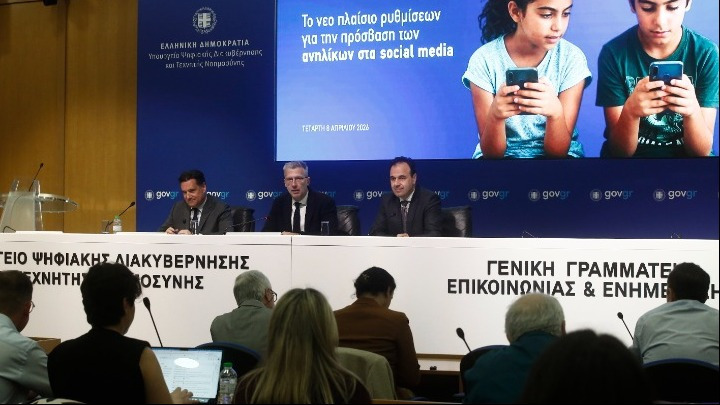
A strategic plan to restrict the access of minors to social media – a historic measure by both Greek and European standards – was presented by the Greek government on April 8, following its announcement by Prime Minister Kyriakos Mitsotakis. Minister of State Akis Skertsos, Health Minister Adonis Georgiadis and Digital Governance and Artificial Intelligence Minister Dimitris Papastergiou presented the details of the plan, which aims to address the problem of digital addiction and protect the mental health of the young.
Skertsos: This initiative is a “personal wager” for the Prime Minister
“Greece is not simply following developments but shaping the European agenda. The prime minister, Kyriakos Mitsotakis, in his letter to the European Commission president, has raised this issue at the heart of the EU. We propose five specific additions to the DSA legislation, seeking mandatory age verification throughout Europe and a common digital age of maturity at 15 years,” Skertsos said.
“We will immediately begin an intensive diplomatic effort. In the second trimester of 2026, we will enter the phase of European consultation, with the aim of voting on a national law in the summer of 2026. The full implementation of the ban will begin in January 2027. We want our children to once again rediscover their time in the physical world, with company, in sports and games,” he added.
“Scrolling with no limits is harmful for the mental health of our children. This is a necessary and sufficient measure. We have a responsibility on a national and European level,” Skertsos said.
Georgiadis: ‘The figures reveal a silent pandemic’
According to Georgiadis, it was important not to allow “the mental health of our children to be controlled by the algorithm”, while he cited worrying epidemiological data that made the measure imperative and revealed that internet addiction was becoming “a silent pandemic”.
“The figures we have at our disposal are shocking. A 23 pct of 15-year-olds in Greece state that they feel insecurity and irritation when they do not have access to their phones. This is the first sign of addiction,” he stressed.
Outlining its consequences, Georgiadis focused on three main areas: physical health, mental health and psychosocial impacts. “The sedentary lifestyle imposed by endless scrolling leads to an exponential increase in childhood obesity, sleep disorders and eye problems. We are seeing a meteoric increase in anxiety, depression and, worst of all, suicidal ideation due to cyberbullying and unrealistic standards that are being promoted. Children are losing their ability for concentration and socialisation. A digital isolation is created that sabotages their later adult life”, he pointed out, stressing that the government’s action was not punitive but protective.
Papastergiou: Protection through the Kids Wallet and stiff penalties
The Digital Governance Minister then outlined the ways that technology will be used as a means of protecting children, rather than as a threat.
“The legislation will make the platforms face their responsibilities. In the framework of the DSA, companies are obliged to implement reliable mechanisms for verifying age. We offer a solution via the Kids Wallet in the gov.gr Wallet. ‘Age tokens’ will be used. This means that the platform will only know that a user is over 15, without having access to any other personal or identifying information. We are ensuring 100% privacy,” Papastergiou said.
In terms of supervision and sanctions, the minister was clear that these will be extremely tough and that we “will not let anyone off lightly”. He noted that these could reach as high as 6% of the global turnover of these companies, as envisaged in the European framework, while supervision will be constant, with random but very thorough inspections.
“In short, we will create an environment where the safe operation of platforms in the only option,” he concluded.