ISTANBUL (ANA-MPA/M. Zacharaki) –
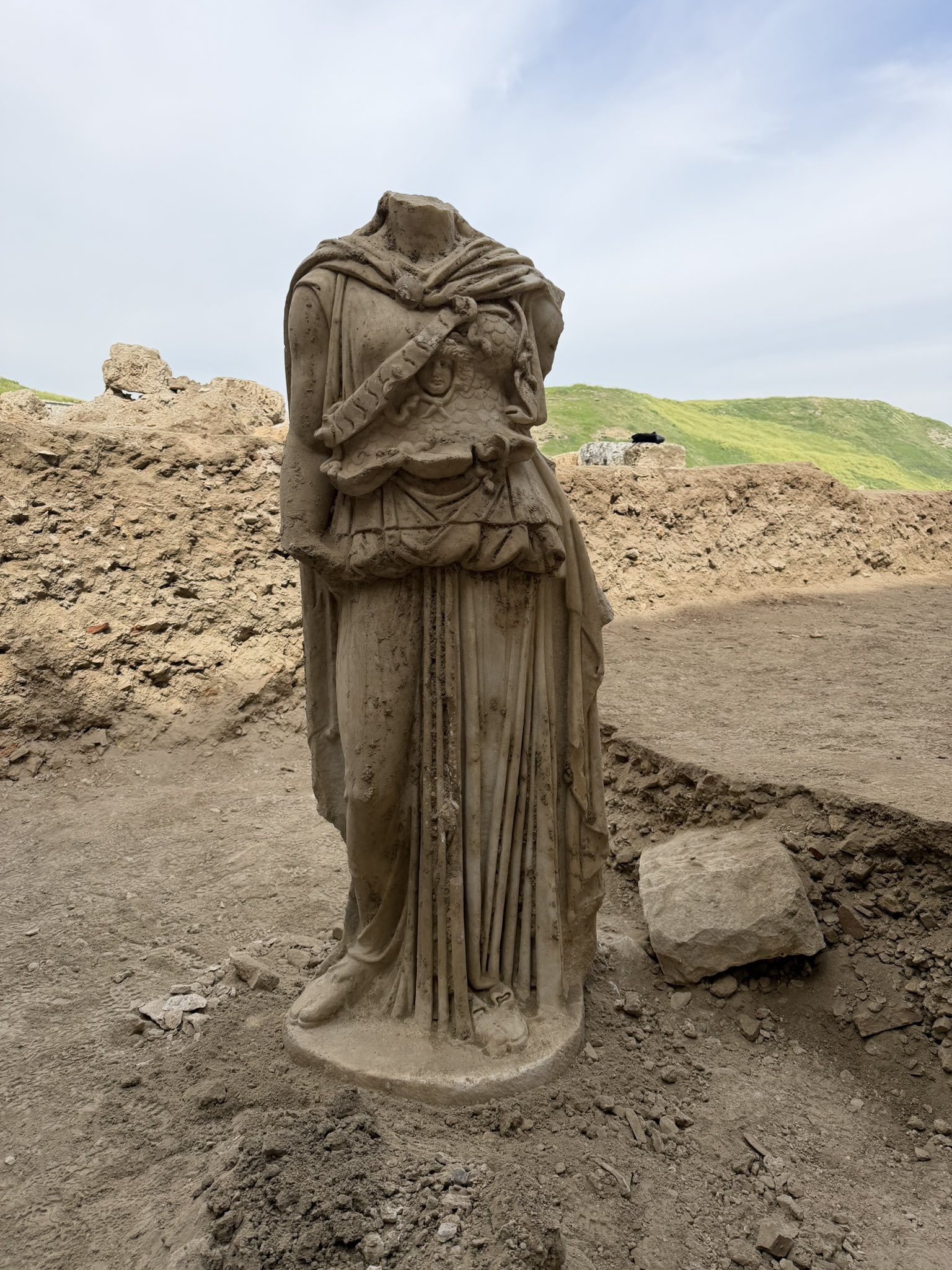
A large marble statue of the ancient Greek goddess Athena was found during excavations by Pamukkale University at ancient Laodikeia (or Laodicea) in western Türkiye.
The nearly 2-meter statue was found headless and facing down at the area of the so-called West Theater, which seems to have been used as a theater for Homer’s epics and a cultural center for other events. Specifically, it was found in debris on the theater’s outer wall (the metascenium, or scena). Its head has not been found yet.
The statue depicts the goddess Athena standing on a round base, wearing a veil and a chlamys around her neck, while the aegis shown on her chest depicts the head of Medusa with snakes. The garment’s folds and the statue’s natural-like stance highlight the artist’s high skill. The back of the statue is rough, which suggests that it was placed between columns.
The West Theater’s stage has three floors with 16 columns each and is dated to the 2nd century CE. Other sculptures found at the site depict scenes from the Odyssey, such as the land of the Laestrygonians, Polyphemus’ Cave, and Scylla. Excavations of the 2024-2025 season revealed multiple statues related to scenes from the Odyssey, supporting the conclusion that Laodikeia was a significant cultural center of antiquity.
In a statement, Turkish Minister of Culture and Tourism Mehmet Nuri Ersoy said, “We have made yet another important discovery in Laodikeia! A new artifact has come to light in the ancient city. The works we are carrying out at Laodikeia’s West Theater continue to reveal traces of the past. At the site, we discovered a statue of Athena, nearly 2 meters long, made of white marble.” As Ersoy said, the statue reflects the classical style of the Augustan period, and is of outstanding quality. Under the program ‘Heritage for the Future’, Turkiye continues to protect this unique heritage and pass it on to the future, he added.
Laodikeia, six kilometers north of modern-day Denizli and extending over 5 sq km, is listed on UNESCO’s Tentative List of World Heritage Sites, and is one of the seven churches of Asia Minor mentioned in the Book of Revelation. According to the listing entry on UNESCO’s site, excavations show that the city was settled continuously from the Chalcolithic Period (Copper Age, 5500 BCE) to 7th century CE. The settlement was founded as a city in the Hellenistic Period by Seleucus Antiochus II in the name of his wife Laodike around the middle of the third century BCE, and later became part of the Roman Republic before being abandoned in the 7th century CE due to repeated earthquakes. Most of the structures and the city itself developed during its golden age, from 1st to the 5th centuries CE.