NEW YORK –
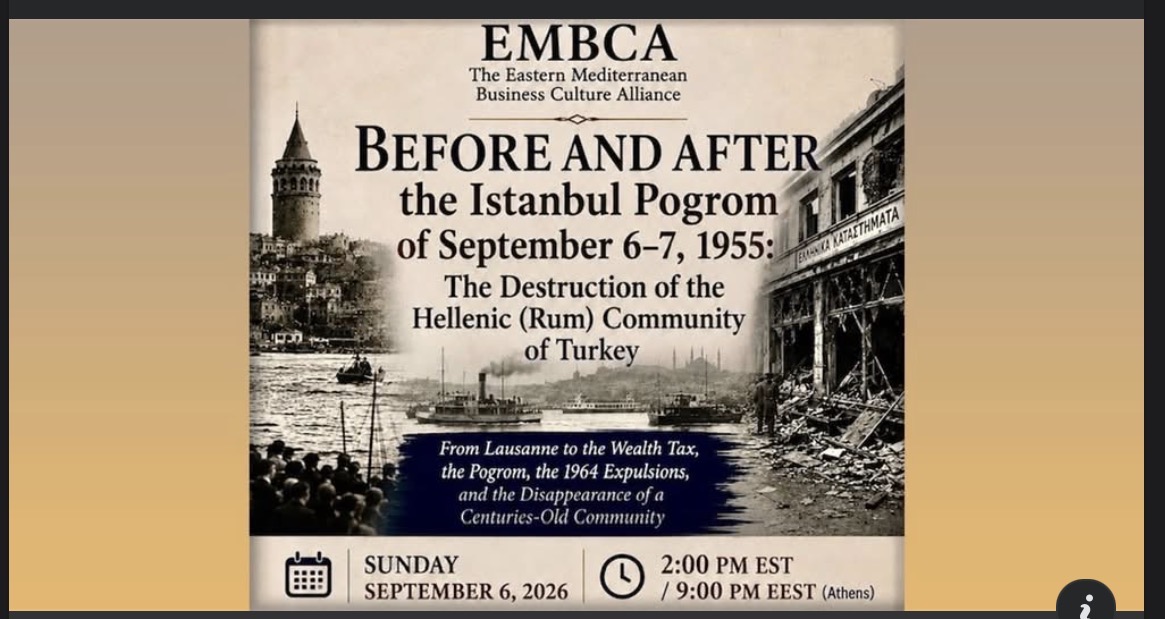
The East Mediterranean Business Culture Alliance (EMBCA) presents ‘Before and After the Istanbul Pogrom of September 6-7, 1955: The Destruction of the Hellenic (Rum) Community of Turkey’ Webinar Panel Discussion on Sunday, September 6, 2 PM EDT/ 9 PM Athens (EEST).
The discussion will be introduced and moderated by Lou Katsos, President of EMBCA. The distinguished panel will include Dr. Alexandros K. Kyrou, Professor of History and Director of the Program in East European and Russian Studies at Salem State University; Dr. Konstantinos Tsitselikis, Professor of Human Rights and International Organizations at the University of Macedonia; Dr. Elizabeth H. Prodromou Professor in the International Studies Program at Boston College; Prof. Dr. Johannes Niehoff-Panagiotidis of the Freie Universitat Berlin; Dr. Harry G. Dimopoulos, International Businessman and 1955 Pogrom Survivor; and Stelios Taketzis, Producer and former Executive Director of COSMOS FM.
At the time of the Treaty of Lausanne (1923), approximately 100,000 Greeks remained in Constantinople, representing 12-15% of the city’s population. Today, only an estimated 1,500-2,500 members of the historic Rum community remain in a metropolis of nearly 16 million. This dramatic decline resulted from decades of discrimination, economic persecution, organized violence, confiscations, and forced emigration, an announcement by EMBCA states.
The panel will examine the Istanbul Pogrom within the broader context of the 1942 Wealth Tax (Varlık Vergisi), discriminatory legislation, restrictions on minority institutions, property confiscations, and the 1964 expulsions, tracing how these policies dismantled a community that had flourished in Constantinople for nearly seventeen centuries.
The attacks of September 6-7, 1955, were sparked by fabricated reports that Greeks had bombed the Turkish Consulate in Thessaloniki. It was later established that the bomb had been planted by a Turkish employee of the consulate. The false story became the pretext for a coordinated assault on Greek homes, businesses, churches, schools, cemeteries, and community institutions, the announcement continues.
Approximately 4,214 Greek homes, 1,004 businesses, 73 churches, two monasteries, and 26 Greek schools were damaged or destroyed. Between 13 and 16 Greeks, including two Orthodox priests, and one Armenian were killed, while Armenian and Jewish properties were also attacked.
The discussion will also examine the Treaty of Lausanne’s guarantees of minority rights and how those protections were progressively eroded. Beyond recounting the events, the panel will explore broader questions of minority rights, religious freedom, cultural heritage, international law, historical memory, restitution, and justice, and what lessons this history offers for protecting vulnerable minorities today.