NEW YORK (ANA-MPA/G. Garantzioti) [Photos by GANP/ Dimitrios Panagos]
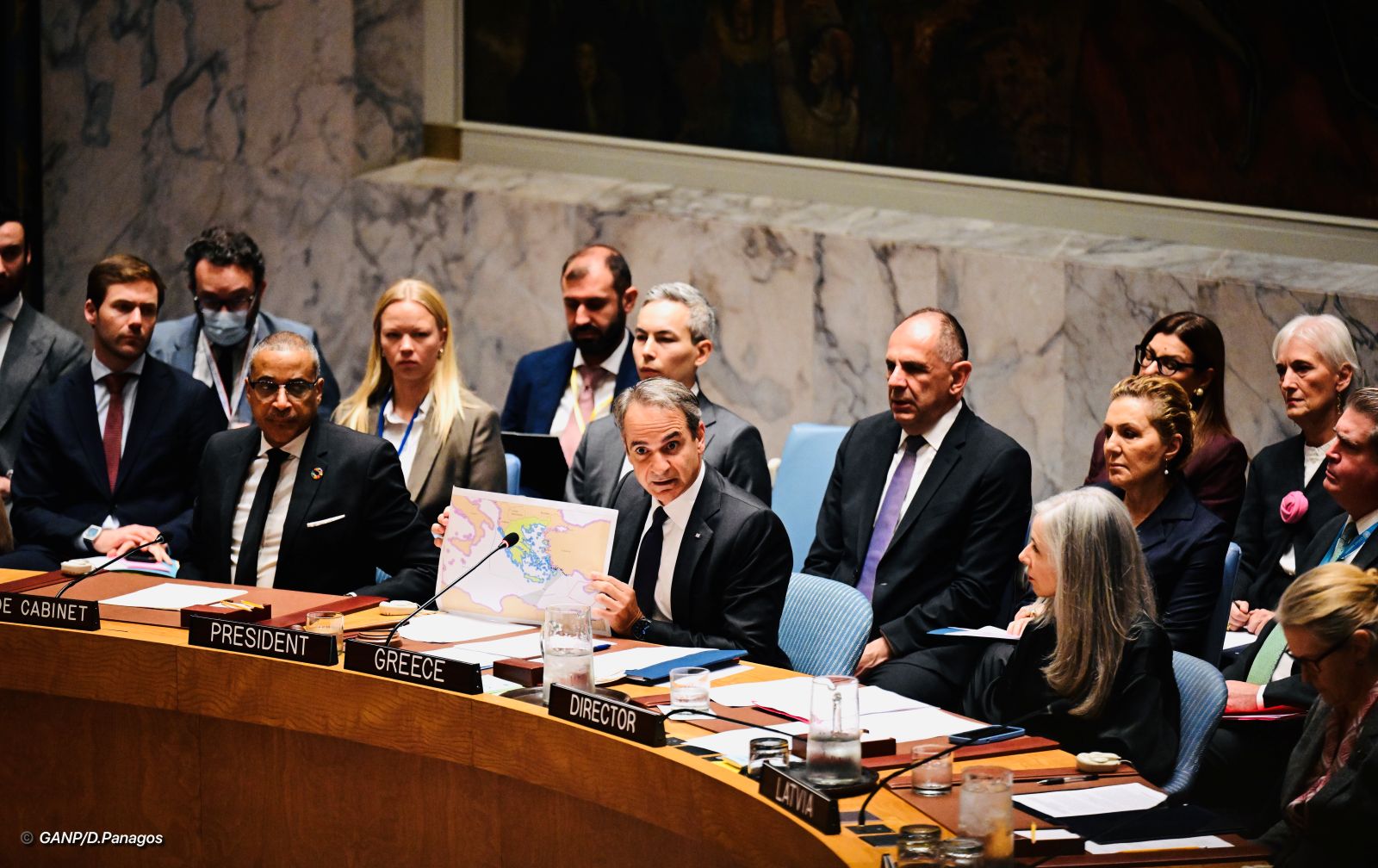
A diplomatic confrontation between Greece and Turkiye over the Turkish-Libyan memorandum unfolded at a UN Security Council meeting on “Emerging Technologies and Maritime Security”, held under the Greek Presidency.
Responding to Greek Prime Minister Kyriakos Mitsotakis, Turkiye’s Permanent Representative to the UN, Ambassador Ahmet Yildiz, said that this Council is “not a maritime delimitation tribunal” and that a map may illustrate a claim, but it cannot adjudicate it. He defended the Turkish-Libyan memorandum, claiming that it “has been in force since 2019”, while noting that the recent parliamentary action in Libya reflected the Libyan people’s support for it.
The Turkish Permanent Representative argued that the memorandum “neither determines nor prejudices the rights of states that are not party to it”. Referring to the Greek islands, he said that Türkiye does not dispute the existence, population or sovereignty of these islands, asserting that “the legal issue is different” and concerns “the effect to be given to the islands when delimiting overlapping maritime claims”.
He invoked “international jurisprudence” arguing that this does not grant islands automatic full effect in maritime delimitation and recalled that Turkiye is not a party to the UN Convention on the Law of the Sea.
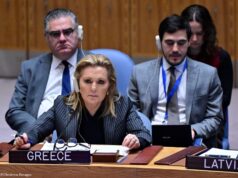
Responding to Turkiye’s allegations, Greece’s Permanent Representative to the UN, Ambassador Aglaia Balta, reiterated Greece’s position that “Greece categorically rejects the so-called Turkish-Libyan memorandum on maritime delimitation”, stressing that it “defies both geography and international law”.
She underlined that its recent so-called ratification by Libya’s House of Representatives can neither confer legality nor alter its legal character as “null and void”, so it thus “produces no legal effect.”
Pointing out that Turkiye and Libya have neither adjacent or opposite coasts capable of generating a common maritime boundary, she stressed that “geography cannot be refashioned”, adding: “It is not a slogan, nor can an agreement between two States prejudice the sovereign rights of a third State..”
Balta also stressed that “international law cannot be selectively applied to accommodate unilateral claims”, adding:
“Greece remains firmly committed to the peaceful settlement of maritime disputes in accordance with international law, as reflected in Ookla’s, as demonstrated by our maritime delimitation agreements with Italy and Egypt. Respect for international law is not a matter of political convenience.”
Responding to Turkiye’s objection to discussing maritime delimitation at the Security Council, she pointed out that respect for the Law of the Sea lies at the heart of maritime security and that “recalling the rules governing our seas is not a misuse of the Council,” but “the very purpose” of it.
In her final intervention, Balta stressed that “Greece has consistently sought good-neighbourly relations with Turkiye, based on mutual respect, international law and the principles of the United Nations Charter.
“We remain committed to dialogue and the peaceful settlement of disputes. However, meaningful dialogue requires respect for international law, sovereignty and sovereign rights,” she concluded.