ATHENS – Greek News USA Staff
There’s fewer now of the most haunting images of Greece’s economic and austerity crisis from 2010-18, people picking through garbage bins for food, even those who used to be well off, suddenly scrounging in the dark for something to supplement what’s on the table.
But those unfortunate enough to be doing it now during the country’s remarkable recovery that hasn’t fully filtered down to the poor and the most vulnerable may find a cornucopia amongst the waste.
While Greek food is regarded as among the best in the world, Greeks don’t always have an appetite for it, and toss more than 2 million tons of uneaten food into the trash annually, the third-highest rate in the European Union.
That’s despite the country’s statistics agency ELSTAT saying that 7 percent of the country’s population faces moderate or severe food insecurity, at odds with the scenes of full restaurants and cafes.
Curiously, most does not come from supermarkets’ unsold inventory which represents 8-13 percent, or about 10 kilos (22 pounds) per person, according to ELSTAT.
Most came from households, 44-53 percent, a stark difference from the crisis days when every grain of rice, strand of spaghetti, drop of olive oil, slice of bread, and tomato was counted out for daily meals.
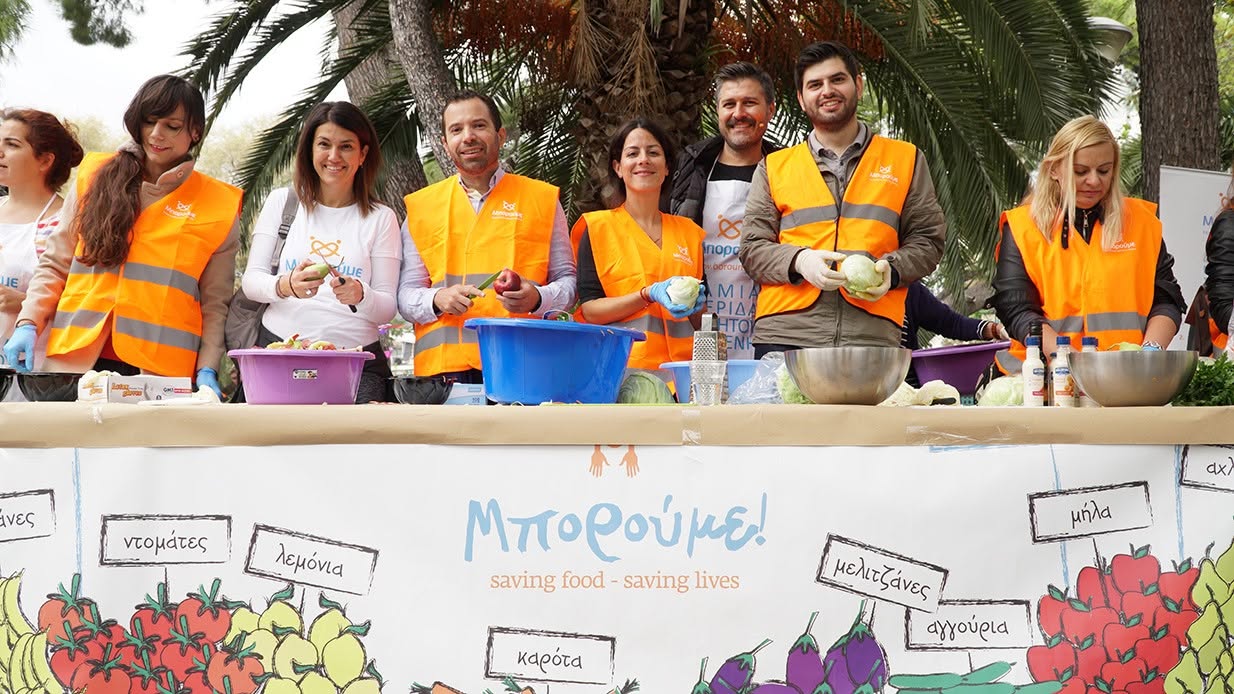
The group BOROUME, the largest decentralized food rescue network in the country, can’t do much about scraps and uneaten leftovers thrown into the rubbish in households, but it does from supermarkets and other sources.
“Beginning in 2011-12 we were observing all the food waste around us … there were people seeking food assistance from soup kitchens from the church and other charities and that struck us as a very negative oxymoron”, Alexander Theodoridis, Co-Founder of the group, told Greek News USA.
With a background in political science and macroeconomics and as an advisor to the Parliament, he helped shape the group – We Can in English – in working to get food delivered instead of thrown away.
It’s not as easy as it sounds. Supermarkets are hamstrung by liability laws that could find them responsible if someone became ill from donated food that was close to its expiration date or had gone bad without notice.
Unlike the United States, Greece does not have a Good Samaritan law to hold harmless the supermarkets, restaurants, cafes, caterers and other sources of food who give it away.
It’s also not cost effective to pull items off shelves, ensuring they are safe to eat, sort and pack given that supermarkets have thin profit margins of 1-2 percent and can’t set aside staff for goodwill work.
Donation is voluntary but the government mandates supermarkets register the precise amount of food waste they generate and surpluses given away annually, on an electronic waste registry platform.
NOT ON THE TABLE
BOROUME found a way to make it work. “We created a food saving model to coordinate pickup of food with the place where the food donor wants to give it”, said Theodoridis of the distribution method.
“You can have any kind of food and save it immediately and make the food donating process easier because when you speak with people it’s a hassle for them to ensure food safety”, he said of working with supermarkets.
The organization said that it saves more than 55,000 portions of food every day through a three-step digital matchmaking process, starting with food donors including households as well as bakeries, supermarkets, corporate events and hotels that log the excess food to be picked up.
The data is run through a database of more than 700 charities, welfare groups, shelters and municipal soup kitchens and software automatically matches the donor with the nearest approved charity needing the food.
The charity uses its vehicles, staff, or volunteers to go directly to the donor’s location to transport the food back to their kitchen, cutting out the middleman and reducing food safety risks.
There’s a cruel irony to so many Greeks needing food during a time of plenty and in a country known for its cuisine, the Mediterranean Diet and the sense that prosperity has returned – but not to all.
Those without have to skip meals, eat less than they need or run out of food due to lack of money because of the high cost of living, inflation and food prices: Greeks are among the lowest paid and highest-taxed in the EU.
Some 1.6 percent go an entire day or more without eating, the statistics agency said and the dire straits was shown in a report by Professors Dimitris Nentas and Klimis Ntalianis of the University of West Attica.
That showed 11.3% cannot afford a proper meal containing meat, fish, or a vegetarian equivalent every other day. Among those already living below the official poverty line, it is 41.6 percent.
BOROUME has provided more than 400,000 meals to organizations and provides more than 1,000 meals a day on average to those in need who are not in restaurants or cafes enjoying the economic comeback.
Food Bank Greece, another organization, is a traditional food repository network which gathers corporate surpluses and short-dated retail items that are suitable for consumption and they are warehoused and distributed to nursing homes, child care centers, and disabled support centers.
“The point is to prevent the creation of surplus food … and to create more awareness in public opinion about how bad it is to waste food environmentally, socially and economically,” said Theodoridis.
A little tossed out in each household amounts to a lot, he said. “If you’re talking about households there are millions of them in Greece and if you project all the food waste in a year you can see how big it is.”