ATHENS – [ANA-MPA]
The oldest known wooden tools in the world, used 430,000 years ago, were discovered in Megalopolis in Arcadia by an international team of researchers from Germany, the United Kingdom and Greece. “This area was very important for human evolution throughout Europe,” the Greek head of the study, paleoanthropologist Katerina Harvati, told ANA-MPA.
The findings come from the archaeological site of Marathousa 1, which dates to the Lower Paleolithic period, a period that began 2.5 million years ago, lasted until approximately 300,000 BC and was characterised by the appearance of early humans (hominoids) and the first tools.
The excavation in the Megalopolis area has been ongoing for a long time, from 2013, when the site of Marathousa 1 was discovered during a surface survey, until 2019, when systematic excavation stopped. During the excavation, stone and bone artifacts were found, that is, objects that have been processed by humans, as well as mammal bones. However, the researchers’ interest was also attracted by something even rarer: wooden finds, which were studied in detail.
In a scientific article, led by Professor Katerina Harvati, Director of the Senckenberg Centre for Human Evolution and Palaeoenvironment at the University of Tübingen, and Dr. Annemieke Milks of the University of Reading, published in the journal PNAS, the study of 144 wooden finds from the excavation of the period 2015-2019 was presented.
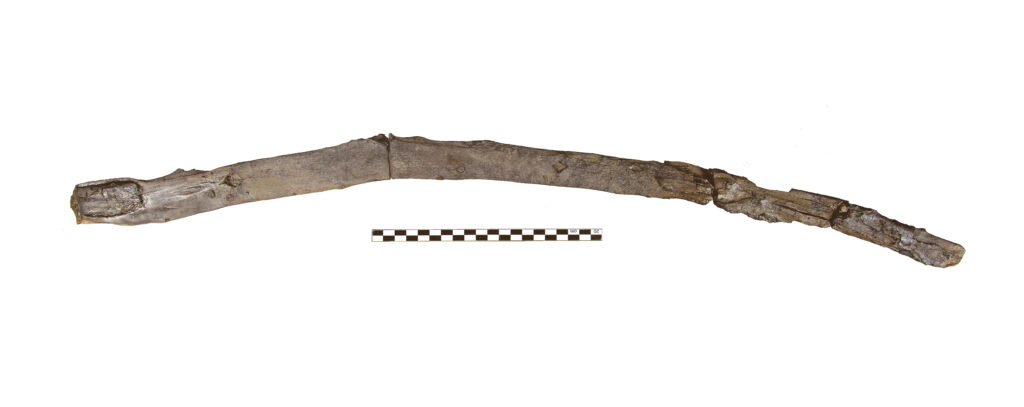
This study concluded with certainty that two finds are wooden tools. One is a piece of a small alder trunk, like a stick, which bears clear signs of processing and signs of use and was probably used for digging on the shores of the lake or for removing tree bark.
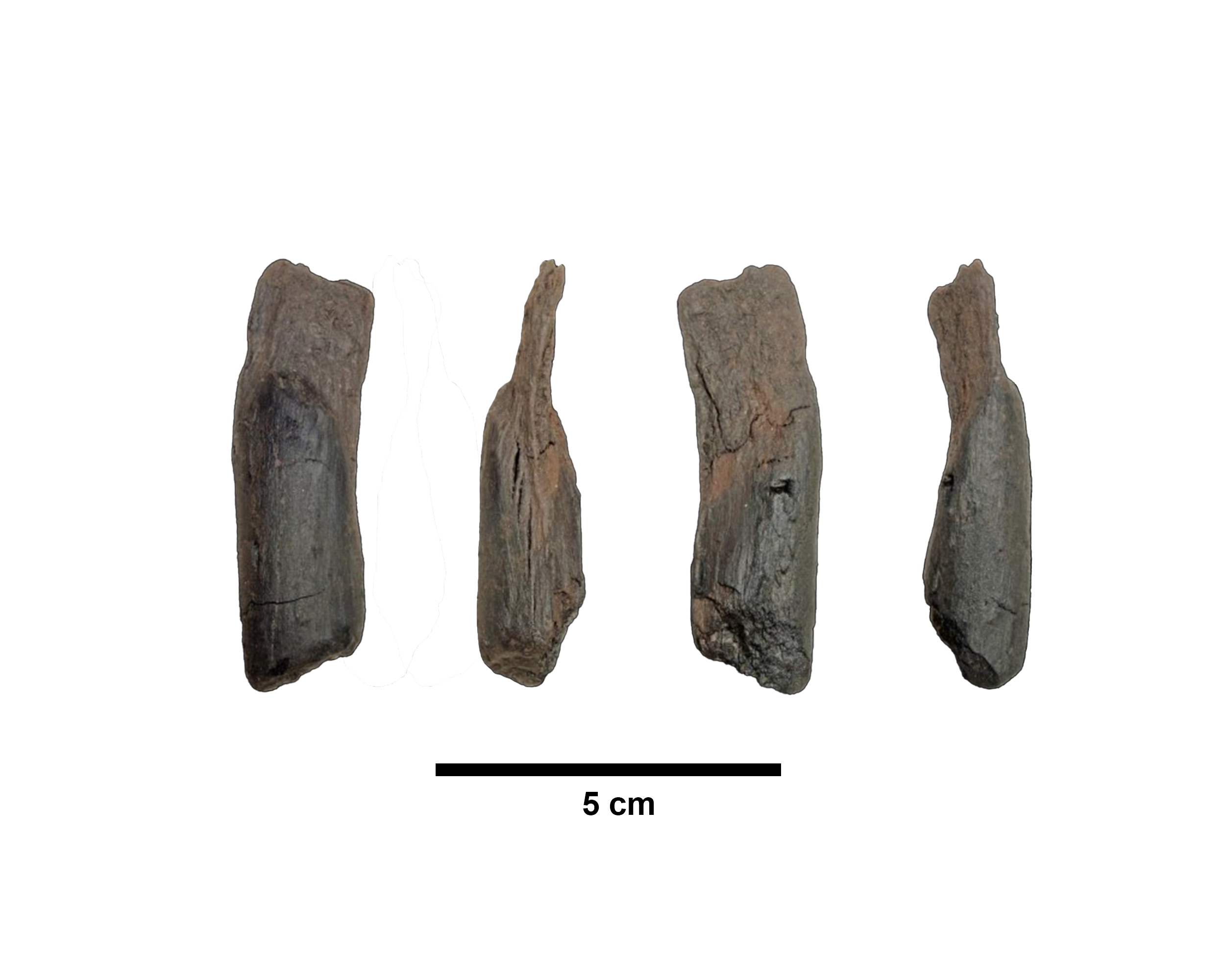
The second is a very small piece of willow or poplar wood, which also shows signs of processing and possible signs of use. This find is an unknown type of tool to date and the researchers have not reached any conclusions about its use. “This tool broadens our horizons and knowledge of the technology with which they created the tools,” the head of the study, Katerina Harvati, a leading expert in human evolution, emphasised to ANA-MPA.
A third find mentioned in the publication, a larger piece of alder trunk with deep grooves, appears to have been shaped by a large carnivore, probably a bear, and not by a human, according to the researchers. Five other findings are also presented, which are likely to be artifacts, but further studies are needed to draw a safe conclusion.
Unique conditions for the preservation of wooden objects
The site dates back to 430,000 years ago, making these finds the oldest wooden artifacts ever found, pushing back the use of this type of tool by at least 40,000 years. As the researchers pointed out, the oldest known wooden tools to date come from the United Kingdom, Zambia, Germany and China and include spears, digging sticks and tool handles. However, all are more recent than the findings at Marathousa 1. The only older evidence of wood use comes from the Kalambo Falls site in Zambia, dated to around 476,000 years ago. However, this was not used as a tool, but as a building material.