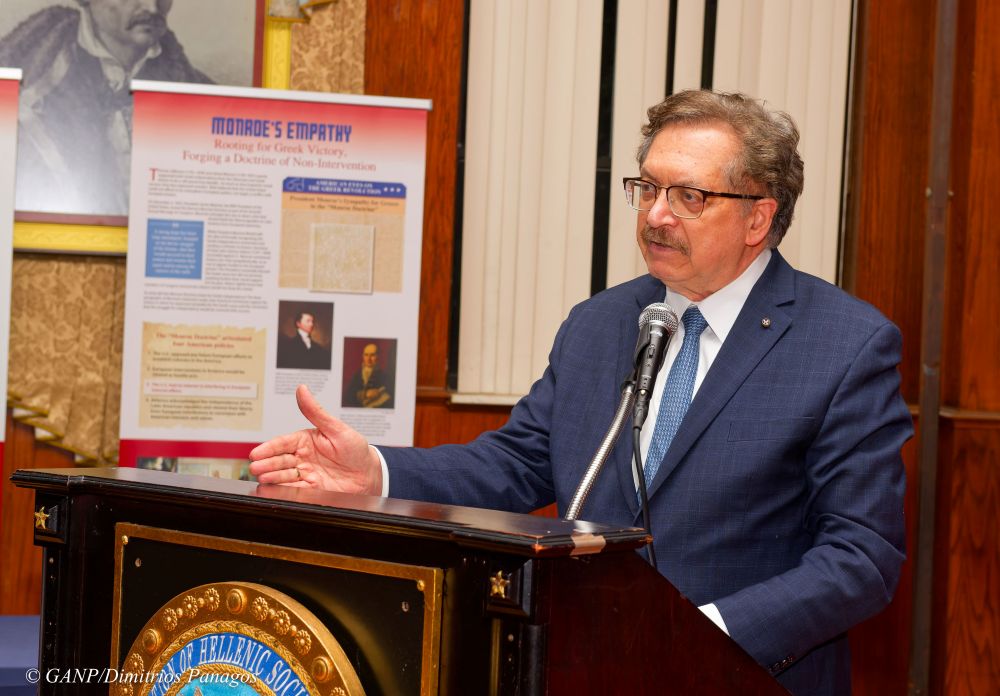
NEW YORK, NY – GNUSA [Photo: GANP/ Dimitris Panagos]
The Eastern Mediterranean Business Culture Alliance [EMBCA] presents “1776 America / 1821 Hellas: Bridging Revolutions – Reflections Across Time” Webinar Panel Discussion on Sunday, May 31, at 2:00 P.M. EST / 9:00 P.M. Athens EEST.
The discussion will be introduced and moderated by Lou Katsos, President of the East Mediterranean Business Culture Alliance (EMBCA), who will also contribute to the discussion. The distinguished panel, currently in formation, will include Constantine G. Hatzidimitriou, Author and Historian, Alexander Billinis, Author, Writer, and Clemson University Lecturer and Eric Hill — Technologist, MMA Instructor, and Martial Artist.
As part of its continuing exploration of the historical, cultural, and civilizational ties linking the Eastern Mediterranean, Europe, and the United States, EMBCA will present this timely discussion examining the profound relationship between the American Revolution of 1776 and the Greek Revolution of 1821, two defining struggles for liberty connected through ideals, sacrifice, memory, and historical influence.
“The webinar will explore how the revolutionary spirit of one era inspired another, shaping democratic thought, constitutional governance, national self-determination, and the enduring global pursuit of freedom”, notes Lou Katsos, explaining that the panel will reflect upon the philosophical, political, and spiritual currents linking the Founding Fathers of the United States with the rebirth of the modern Hellenic state, while examining the roles of Philhellenism, classical heritage, faith, sacrifice, diplomacy, and revolutionary identity in shaping both nations.
Special attention will also be given to how the Greek Revolution profoundly affected the United States itself, inspiring Philhellenic movements, humanitarian activism, literature, education, and broader American discussions surrounding liberty and national identity.
The discussion will further explore the Revolution’s influence upon the American abolitionist movement and the early women’s suffrage movement, particularly through the activism of Philhellenic women who connected the Greek struggle for freedom with broader human rights and democratic causes.